
India’s Growth Model Now Depends on Manufacturing, Energy Imports and Policy Credibility
India remains one of the world’s strongest large-economy growth stories, but the next phase will be judged by whether manufacturing momentum, energy security and macroeconomic discipline can move together. India’s growth story is no longer only a question of headline GDP. It is becoming a test of structure. For much of the last decade, India’s […]
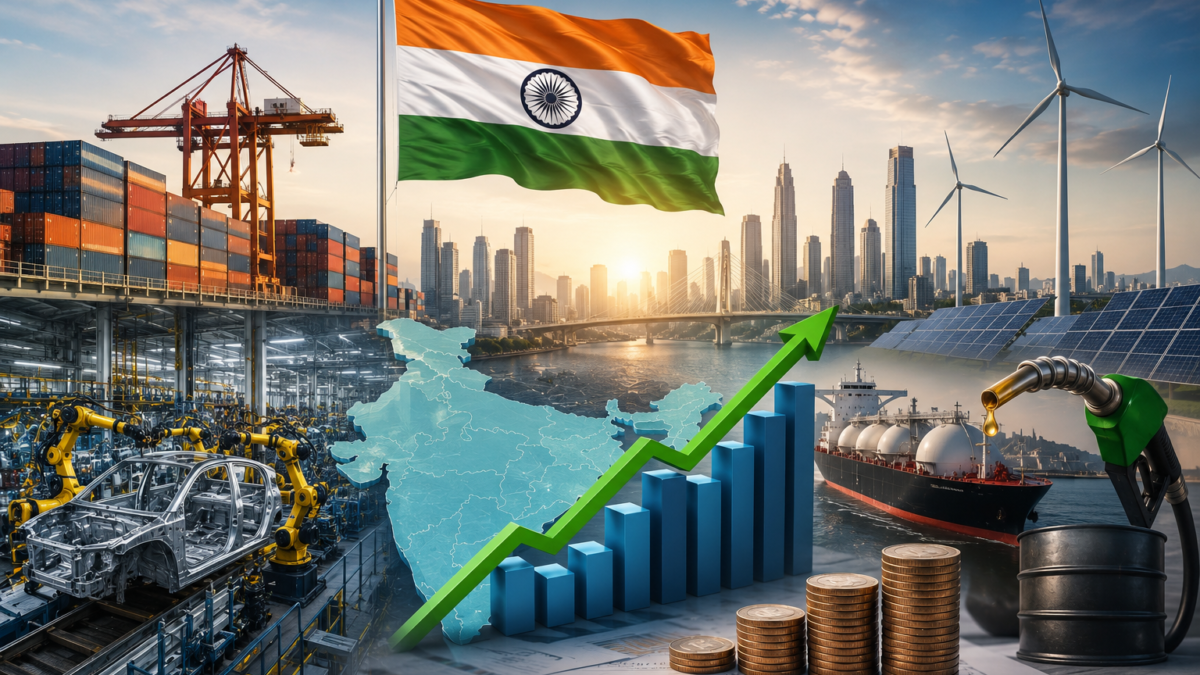

India remains one of the world’s strongest large-economy growth stories, but the next phase will be judged by whether manufacturing momentum, energy security and macroeconomic discipline can move together.
India’s growth story is no longer only a question of headline GDP. It is becoming a test of structure.
For much of the last decade, India’s macroeconomic appeal rested on a familiar combination: a large domestic market, a deep services base, rising digital adoption, strong public infrastructure spending and improving financial formalisation. That story remains intact. But the next phase is more demanding. Investors are no longer asking only whether India can grow. They are asking what kind of growth India can sustain.
That distinction matters. A country can grow quickly for several years through public capital expenditure, consumption recovery, credit expansion and services exports. Sustained economic power requires something deeper: manufacturing scale, energy security, credible inflation management, fiscal discipline, export competitiveness and institutional predictability.
The World Bank’s April 2026 India Development Update described India as remaining among the fastest-growing major economies, while also warning that global uncertainty, energy-market disruption and geopolitical risks could affect the outlook. It projected that India’s strong macroeconomic buffers offer protection, but stressed the importance of energy diversification, prudent fiscal management and trade diversification.
That is the central issue. India’s growth model is strong, but it is not automatic. It must now absorb a world of unstable energy prices, tariff politics, supply-chain shifts and tighter scrutiny from global capital.
Manufacturing is becoming the credibility test
India’s ambition to become a developed economy cannot rest on services alone.
Services have given India global influence. Information technology, business services, digital platforms and skilled professional exports have helped build foreign exchange strength and international visibility. But a services-led model has limits. It does not absorb labour at the scale required by India’s demographic structure. It does not automatically create deep industrial supply chains. It does not fully solve the challenge of formal employment.
That is why manufacturing matters.
Recent industrial data gives policymakers some encouragement. India’s industrial output grew 7.3% in June 2026, its fastest pace in nearly two years, supported by manufacturing and electricity generation. The data was widely read as a sign of resilient domestic demand despite global uncertainty.
But one strong month does not make an industrial transformation. India’s real challenge is consistency. Manufacturing must move from episodic acceleration to durable competitiveness. That requires more than subsidies. It requires reliable logistics, faster clearances, lower compliance friction, stable taxation, cheaper energy, deep supplier ecosystems and better workforce alignment.
This is where the growth model becomes institutional. Factories do not move because a slogan is attractive. They move when costs, rules, land, energy, labour and supply chains make commercial sense. India’s opportunity is real, especially as companies diversify away from excessive dependence on one production base. But opportunity must be converted into execution.
Energy imports remain the hidden vulnerability
The most important constraint on India’s growth story may not come from demand. It may come from energy.
India is a fast-growing economy with rising fuel needs, expanding mobility, industrial demand and urban consumption. That growth increases the country’s exposure to imported energy. When oil prices rise, the effect travels through the economy: the import bill widens, the current account faces pressure, inflation risk increases, fiscal subsidies become harder to manage and the rupee can come under stress.
This is not a theoretical concern. Reuters reported in July 2026 that India’s finance ministry warned a sustained crude-oil price spike could again strain the fiscal deficit and current account balance, especially after Middle East conflict lifted concerns around the import bill and inflation.
India’s crude-import dependence is structurally high. Indian Express, citing Petroleum Planning and Analysis Cell data, reported that India’s reliance on imported crude rose to 88.6% during April–January FY26, compared with 88.2% in the same period of FY25.
This dependence does not mean India is fragile. It means the growth model carries an external-energy sensitivity that cannot be ignored. A country can manage that risk through diversified suppliers, strategic reserves, domestic refining strength, renewable expansion, electric mobility, gas infrastructure and efficiency improvements. But the risk remains part of the macroeconomic equation.
Energy security is therefore not separate from economic strategy. It is part of industrial policy. A manufacturing-led India needs reliable power, affordable fuels, stable logistics and predictable input costs. If energy becomes volatile, manufacturing margins weaken and inflation pressure rises. If energy infrastructure improves, India’s industrial credibility strengthens.
Renewable capacity is necessary, but the grid must catch up
India’s energy transition is often discussed through capacity targets. Capacity matters, but the next stage is about integration.
Solar, wind, batteries, transmission corridors, distribution companies and industrial power demand must work together. A country cannot run a modern manufacturing economy on headline renewable capacity alone. It needs grid reliability, storage, pricing reform, real-time balancing and transmission expansion.
Reuters reported in July 2026 that India was unable to operate nearly 7% of its solar capacity at full output during peak generation hours because of transmission constraints.
That fact is important. It shows the difference between generation ambition and system capability. India can build renewable capacity rapidly, but if transmission and grid management lag, part of that capacity becomes underused. For investors, this creates a clear lesson: India’s clean-energy story is not only about solar panels and wind turbines. It is about the full infrastructure stack.
The same applies to data centres, electric vehicles, green hydrogen, industrial parks and advanced manufacturing. All of them require energy planning. India’s next growth phase will need a power system that is cleaner, larger and more reliable at the same time.
Policy credibility is the real macro asset
India’s greatest macroeconomic advantage is not only growth. It is credibility.
Credibility means investors believe the state will manage inflation, fiscal deficits, external balances and regulation with discipline. It means companies believe rules will not shift unpredictably. It means households believe prices will not become unmanageable. It means global capital believes the rupee, bond market and policy environment can absorb shocks without disorder.
This is why the Reserve Bank of India’s role matters. Monetary policy is not only about interest rates. It is about confidence. If inflation expectations remain anchored, India has more room to support growth. If inflation becomes unstable, the entire macro framework tightens.
Fiscal credibility is equally important. Public infrastructure spending has supported growth and improved long-term capacity. But the quality of spending matters. Capital expenditure that improves logistics, ports, railways, power and urban infrastructure strengthens productivity. Recurrent spending that does not raise capacity can weaken fiscal space.
For India, the task is not to choose between growth and discipline. The task is to make discipline growth-enhancing. That means keeping deficits credible while still investing in infrastructure, health, education, energy and manufacturing ecosystems.
The rupee is a signal investors watch closely
Rupee stability is not about defending a particular number. It is about avoiding disorder.
A flexible currency helps absorb shocks. But sharp depreciation can worsen imported inflation, raise external debt concerns, affect corporate balance sheets and weaken sentiment. For an energy-importing economy, the currency and crude oil are linked. Higher oil prices can widen the import bill. A weaker rupee can make oil more expensive in domestic terms. That combination can create pressure on inflation and public finances.
This is why global investors watch India’s foreign-exchange reserves, current account, inflation data and RBI communication closely. They are not looking for a perfectly fixed currency. They are looking for a credible macro framework.
India’s advantage is that it has built stronger external buffers than in earlier decades. But buffers are not a substitute for reform. They give time. They do not remove the need for energy diversification, export competitiveness and manufacturing depth.
The Economic Statesman view
India’s growth model is entering its most serious phase.
The first phase was about proving that India could grow at scale. The next phase is about proving that India can grow with structure. That means manufacturing must become more competitive, energy dependence must be managed intelligently, renewable infrastructure must be integrated properly and macroeconomic policy must remain credible.
The opportunity is substantial. Supply chains are shifting. Global companies want alternatives. Domestic demand is large. Digital infrastructure is deep. Public investment has improved physical connectivity. India has the scale to become one of the defining economies of the next decade.
But scale alone is not strategy.
India’s growth story will be strongest if it connects industrial ambition with energy realism and policy discipline. Manufacturing without energy security will remain vulnerable. Energy transition without grid readiness will remain incomplete. Growth without fiscal and monetary credibility will eventually face market resistance.
The next India story will not be written only by GDP numbers. It will be written by the quality of the system behind those numbers.
Anika Sen
Anika Sen writes on export controls, supply-chain security, strategic manufacturing and the economics of technology policy.