
Why AI Data Centres Are Becoming the New Energy Policy Battleground
Artificial intelligence is no longer only a technology story. As data centres demand more electricity, land, cooling, capital and grid access, governments are being forced to treat AI infrastructure as a core question of energy security and industrial policy. Artificial intelligence has moved faster than the physical systems built to support it. The public sees […]
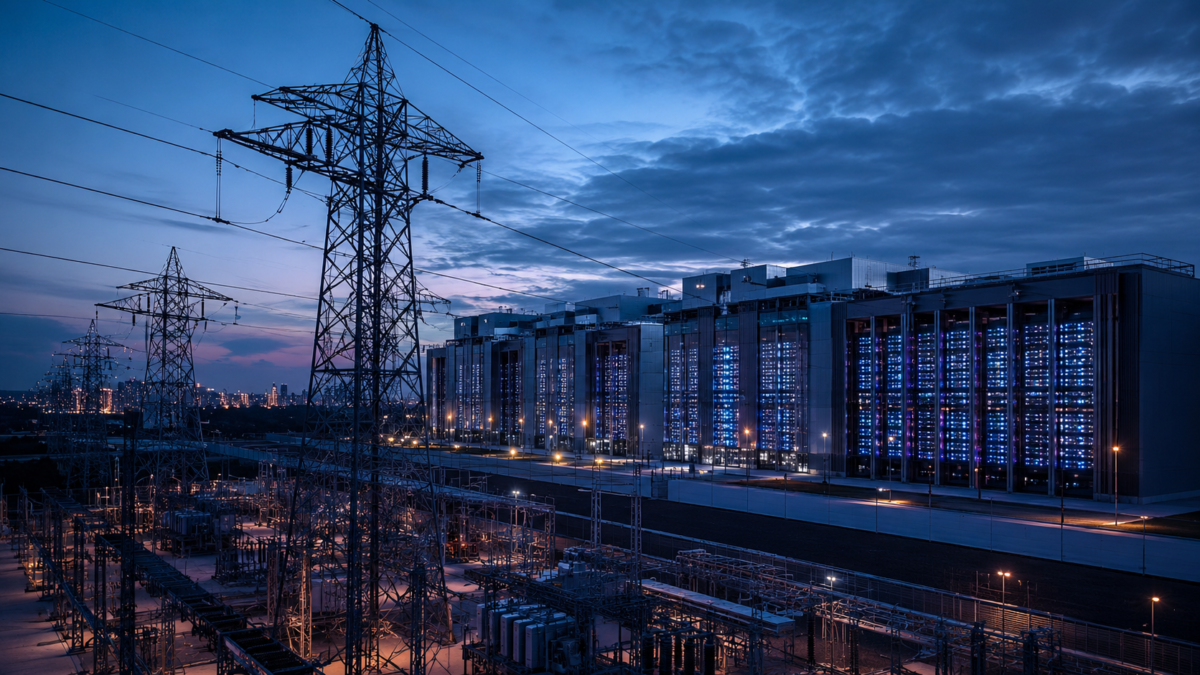

Artificial intelligence is no longer only a technology story. As data centres demand more electricity, land, cooling, capital and grid access, governments are being forced to treat AI infrastructure as a core question of energy security and industrial policy.
Artificial intelligence has moved faster than the physical systems built to support it. The public sees AI through chatbots, automation tools, chips and software platforms. Governments increasingly see something else: a fast-growing industrial infrastructure that consumes electricity, requires grid access, competes for land, demands cooling, and concentrates strategic capacity in places able to supply reliable power.
That is why AI data centres are becoming an energy policy battleground. They sit at the intersection of technology, electricity markets, national competitiveness, climate targets and infrastructure planning. A country may announce an AI strategy, but that strategy becomes hollow if it cannot provide the power, transmission capacity and permitting system required to operate high-performance computing at scale.
The International Energy Agency estimates that global electricity consumption from data centres could more than double to around 945 terawatt-hours by 2030, equal to just under 3% of global electricity consumption in its base case. The IEA has also noted that data centres account for around one-tenth of global electricity demand growth to 2030, which is significant but still smaller than the demand growth from industrial motors, air conditioning and electric vehicles. The point is not that AI will consume all available power. The point is that its demand is concentrated, fast-moving and politically visible.
The problem is not only how much power AI uses
The energy debate around AI often begins with a large number: how much electricity data centres may consume by 2030. That number matters, but it does not fully explain the policy challenge.
The harder question is where the demand arrives, how quickly it arrives, and whether the grid is ready to absorb it. A new data centre campus can require large blocks of firm power in a specific location. It cannot always wait for transmission expansion, power-plant permitting or local distribution upgrades. In many markets, electricity planning was built around gradual demand growth from households, industry and cities. AI changes the rhythm. It creates large, concentrated loads that can arrive faster than the grid’s ability to adapt.
This is why energy ministers, regulators and utilities are now part of the AI conversation. The most important constraint may not be the availability of chips alone. It may be the ability to connect those chips to dependable power without destabilising local grids, increasing consumer tariffs or delaying other industrial projects.
The IEA has warned that AI training and model use can create large and rapid power swings, making energy storage and reliability planning more important than in traditional data-centre operations. That matters because electricity systems must balance supply and demand continuously. If AI workloads become more volatile, they become not only a demand issue but an operational issue for the grid.
AI infrastructure is becoming industrial policy
For decades, data centres were treated largely as digital infrastructure. They supported cloud computing, enterprise software, search, social media and consumer platforms. AI has changed their strategic meaning.
A modern AI data centre is closer to an industrial facility than a normal office asset. It requires enormous capital expenditure, specialised chips, cooling systems, fibre connectivity, backup power, grid interconnection, water or alternative cooling arrangements, and long-term energy contracts. The countries and regions that can offer these inputs will attract AI infrastructure. Those that cannot may remain software consumers rather than infrastructure owners.
This is where energy policy becomes economic statecraft. Governments want AI capacity because it affects productivity, defence, research, finance, healthcare, education and administrative capability. But AI capacity depends on power. A national AI strategy therefore becomes partly a grid strategy, partly a permitting strategy, partly a land-use strategy and partly a capital-allocation strategy.
The countries that solve this coordination problem will have an advantage. They will be able to attract hyperscale investment, build domestic AI ecosystems and keep strategic computing capacity within their jurisdiction. Countries that fail to solve it may face the opposite problem: they may produce AI ambitions on paper while importing digital intelligence from infrastructure built elsewhere.
The political conflict: who gets the power?
AI data centres create a politically sensitive allocation problem. Electricity is not merely a commercial input. It is a public necessity. Households need affordable power. Factories need predictable power. Cities need reliable power. Climate policy needs clean power. Now AI data centres are entering the same queue.
If a region gives grid priority to data centres, other users may ask why. If utilities build new capacity for AI customers, regulators may ask who carries the cost. If fossil-fuel generation is extended to meet data-centre demand, climate advocates will object. If data centres rely only on renewable claims without matching real-time grid needs, power-system operators may remain unconvinced.
This creates a new social contract around digital infrastructure. It is no longer enough for technology companies to say they are investing in AI. They must show how that investment fits into the wider energy system. Are they funding new clean generation? Are they paying fairly for grid upgrades? Are they using flexible demand? Are they building storage? Are they recycling heat? Are they using water responsibly? Are they locating in places where the grid can actually support them?
The IEA’s 2026 analysis also highlights the limits of simple self-supply solutions. It found that providing reliable onsite gas-fired electricity for critical and variable data-centre load may require overbuilding onsite generation infrastructure by 30% to 70% relative to demand. That is a reminder that energy reliability cannot be solved by slogans. It requires engineering, redundancy and cost.
Why this matters for investors
For investors, the AI-energy link changes how data-centre assets should be valued. The old model focused heavily on location, tenants, connectivity and real estate. The new model adds power certainty as a central investment variable.
A data centre with secured grid connection, long-term power contracts and credible cooling strategy may deserve a premium. A project with land but no power may be little more than a speculative site. In some markets, power availability could become more valuable than land availability. This changes the economics of infrastructure funds, utilities, renewable developers, grid companies, chip firms and cloud platforms.
It also changes risk. A project can be delayed not because demand is weak, but because the grid queue is full. A company can have customers ready but no connection approval. A country can have political ambition but insufficient transmission. These are not software risks. They are infrastructure risks.
That is why energy companies are now part of the AI investment story. Power producers, battery developers, nuclear firms, grid operators, gas suppliers and renewable platforms may all become indirect beneficiaries of AI growth. The market is beginning to understand that the AI economy is not only a semiconductor cycle. It is also an electricity cycle.
Climate policy now has to deal with compute demand
The clean-energy question is more complicated than either side admits. AI data centres can increase electricity demand and create pressure for new generation. At the same time, AI may improve energy-system efficiency, grid optimisation, forecasting, industrial operations and climate modelling. The technology is both a source of demand and a possible tool for managing demand.
The policy challenge is to prevent AI growth from weakening climate commitments while still allowing infrastructure development. That requires moving beyond annual renewable certificates and toward more credible energy matching, local grid contribution and transparent emissions accounting. Governments may increasingly ask whether data centres are adding clean capacity or merely claiming credit for power that would have existed anyway.
There is also a water dimension. Many data centres require cooling, and in water-stressed regions this can become politically sensitive. Future approvals may depend not only on electricity use but on water use, heat management, land impact and local employment. A data centre that looks efficient on paper may still face community resistance if it appears to consume scarce local resources without broad economic benefit.
The new policy test
The AI data-centre boom forces governments to answer a difficult question: can they build a regulatory system that encourages digital infrastructure without losing control of energy planning?
A serious policy framework would need five elements.
First, transparent grid-connection rules so speculative projects do not block serious ones. Second, location planning that encourages data centres to move toward regions with available power, clean generation and cooling advantages. Third, pricing rules that prevent ordinary consumers from subsidising private infrastructure. Fourth, energy-performance disclosure so policymakers can compare real demand, emissions and efficiency. Fifth, investment coordination between data-centre operators, utilities, renewable developers and transmission planners.
This does not mean governments should block AI infrastructure. It means they should stop treating it as a normal commercial load. AI data centres are now strategic industrial assets. They deserve fast approvals when they strengthen the system, and stricter scrutiny when they create hidden costs for everyone else.
The Economic Statesman view
The AI economy will not be decided only in laboratories, boardrooms or venture-capital meetings. It will also be decided in substations, transmission corridors, permitting offices and energy ministries.
The countries that understand this early will treat AI infrastructure as part of national economic planning. They will connect technology policy with energy policy, grid investment and industrial strategy. The countries that ignore it may discover that AI ambition is easy to announce but difficult to power.
That is why AI data centres are becoming the new energy policy battleground. The next phase of digital power will belong not only to those who build the best models, but to those who can supply the electricity, capital and institutional coordination required to run them.
Anika Sen
Anika Sen writes on export controls, supply-chain security, strategic manufacturing and the economics of technology policy.