GCC Diversification and the Changing Role of Industrial Policy
Gulf governments are reshaping industrial policy to develop manufacturing, technology and non-oil exports. Discover how Saudi Arabia, the UAE, Qatar and other GCC economies are pursuing diversification.
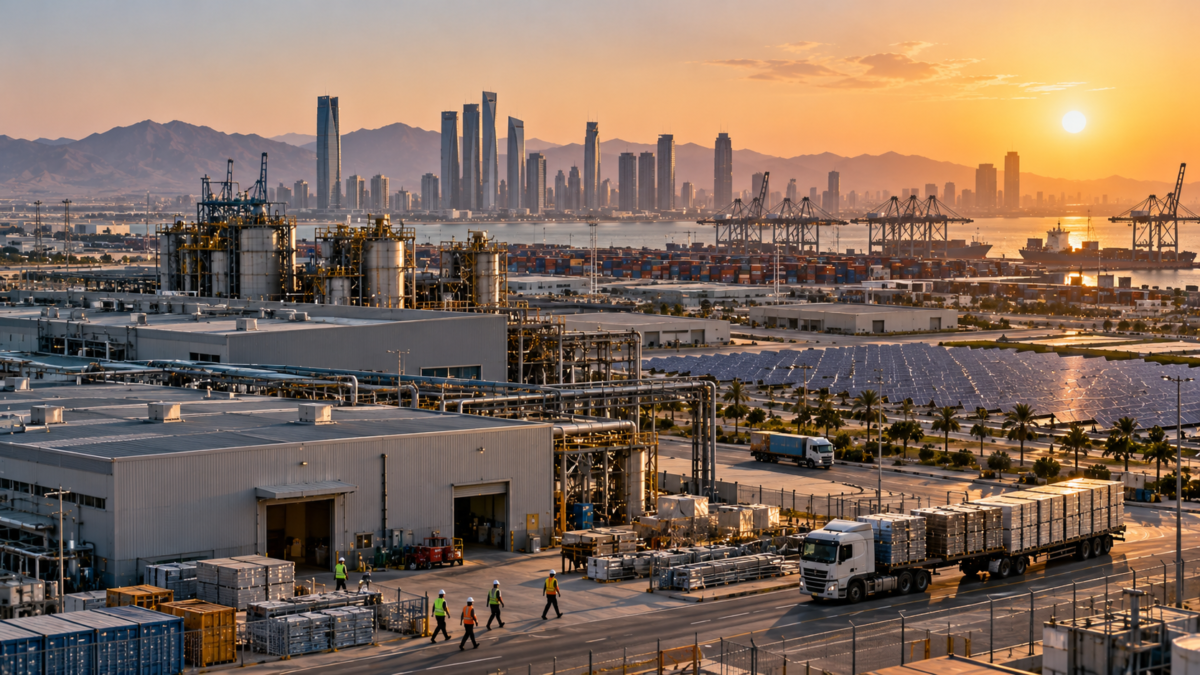

How Gulf governments are using industrial strategy, investment incentives and economic reforms to reduce hydrocarbon dependence and build competitive non-oil industries.
For decades, the economies of the Gulf Cooperation Council (GCC) have relied heavily on oil and natural gas revenues to finance public spending, infrastructure and economic development. Hydrocarbons remain central to government finances and export earnings, but the region’s economic priorities are changing.
Saudi Arabia, the United Arab Emirates, Qatar, Oman, Bahrain and Kuwait are increasingly using industrial policy to encourage manufacturing, attract foreign investment, develop technology capabilities and expand non-oil exports. Governments are moving beyond the traditional role of providing infrastructure and public services towards actively shaping the industries they want to develop.
This shift reflects a wider economic objective: building productive sectors that can generate employment, attract private capital and compete internationally, even when global energy markets become less favourable.
Why Industrial Policy Has Become Important in the Gulf
Industrial policy refers to government measures designed to support the development of selected industries or improve the productive capabilities of an economy.
These measures can include investment incentives, industrial zones, infrastructure development, research funding, procurement policies, export support, skills programmes and access to financing.
For GCC governments, the motivation is closely connected to economic diversification. Oil and gas revenues can fluctuate with global prices and production conditions. An economy that depends heavily on hydrocarbon exports may therefore face pressure when energy markets weaken.
Developing manufacturing and other non-oil sectors can create additional sources of economic activity and revenue. It can also help countries build domestic supply chains, develop technical skills and reduce dependence on imported industrial goods.
The International Monetary Fund’s December 2025 assessment of the GCC documented more than 80 industrial policy measures introduced over the preceding three years in the countries covered by its database. Most were directed towards manufacturing.
This demonstrates how industrial strategy has become an increasingly active part of Gulf economic planning. However, the IMF also cautioned that industrial policy should complement wider structural reforms rather than replace them.
From Oil Revenues to Competitive Industries
The traditional Gulf economic model was built around the production and export of hydrocarbons, supported by public investment and government spending.
The new diversification approach seeks to use the financial resources generated by this model to develop additional industries.
Manufacturing is particularly important because it can create links between several parts of the economy. A factory requires energy, transport, logistics, engineering services, skilled workers, financing and suppliers. As production expands, these connected activities can support wider economic development.
The region has opportunities in petrochemicals, metals, construction materials, food processing, pharmaceuticals, industrial equipment and advanced manufacturing.
Some of these industries benefit from existing Gulf advantages, including energy availability, capital resources, port infrastructure and proximity to major international markets.
However, having access to capital and infrastructure does not automatically create globally competitive manufacturing. Businesses also require reliable suppliers, skilled workers, efficient regulation, technology, quality standards and access to customers beyond domestic markets.
The long-term objective is therefore not simply to establish more factories. It is to create industries capable of producing goods competitively and selling them internationally.
Saudi Arabia: Building an Integrated Industrial Base
Saudi Arabia has placed industrial development at the centre of its economic transformation strategy.
The National Industrial Strategy and the National Industrial Development and Logistics Program (NIDLP) are intended to strengthen manufacturing, mining, energy and logistics as interconnected parts of the national economy.
The approach is designed to improve the contribution of industrial activities to non-oil growth while encouraging private investment and expanding exports.
According to the Saudi Press Agency’s June 2026 report on the NIDLP’s 2025 annual results, activities covered by the programme contributed SAR 1,045 billion to non-oil GDP in 2025. This represented approximately 39% of the Kingdom’s total non-oil GDP, compared with SAR 996 billion in 2024.
The programme connects several strategic areas rather than treating manufacturing as an isolated sector. Energy can support industrial production, mining can provide raw materials, and logistics infrastructure can connect manufacturers with domestic and international customers.
Saudi Arabia is also seeking to develop capabilities in electric vehicles, pharmaceuticals, industrial machinery, defence-related manufacturing and advanced materials.
The challenge will be ensuring that new industrial capacity generates sustainable demand, improves productivity and attracts competitive private-sector participation.
The UAE: Manufacturing, Trade and Technology
The United Arab Emirates has developed its industrial strategy around manufacturing competitiveness, international connectivity and investment attraction.
Its Operation 300bn strategy aims to increase the industrial sector’s contribution to GDP and strengthen the country’s position as a manufacturing and export hub.
The UAE’s advantages include international airports, major seaports, free zones, financial services and established connections with markets across Asia, Europe and Africa.
The country’s industrial ambitions cover sectors such as food production, pharmaceuticals, metals, chemicals, machinery and advanced technology.
Abu Dhabi’s industrial development initiatives and Dubai’s logistics and commercial infrastructure provide different but complementary opportunities for manufacturers.
The UAE is also investing in digital transformation and artificial intelligence infrastructure. These capabilities can support industrial productivity through automation, predictive maintenance, supply-chain management and advanced manufacturing systems.
The main test is whether these investments produce deeper domestic industrial capabilities and higher-value exports rather than primarily expanding trade, distribution and assembly activities.
Qatar: Expanding Manufactu
Farah Siddiqui
Farah Siddiqui writes on Gulf capital, sovereign wealth funds, Middle East diversification and the region’s role in global finance.