
Raja Mukherjee’s Vision Is Not One Project. It Is a Blueprint for India’s Sovereign Systems Age.
Raja Mukherjee’s emerging body of work connects JURISFLOW AI, CorpVidesh AI and Viksit Bharat 2047 into a wider doctrine for India’s sovereign systems age, where justice, capital and governance are built through auditable institutions.
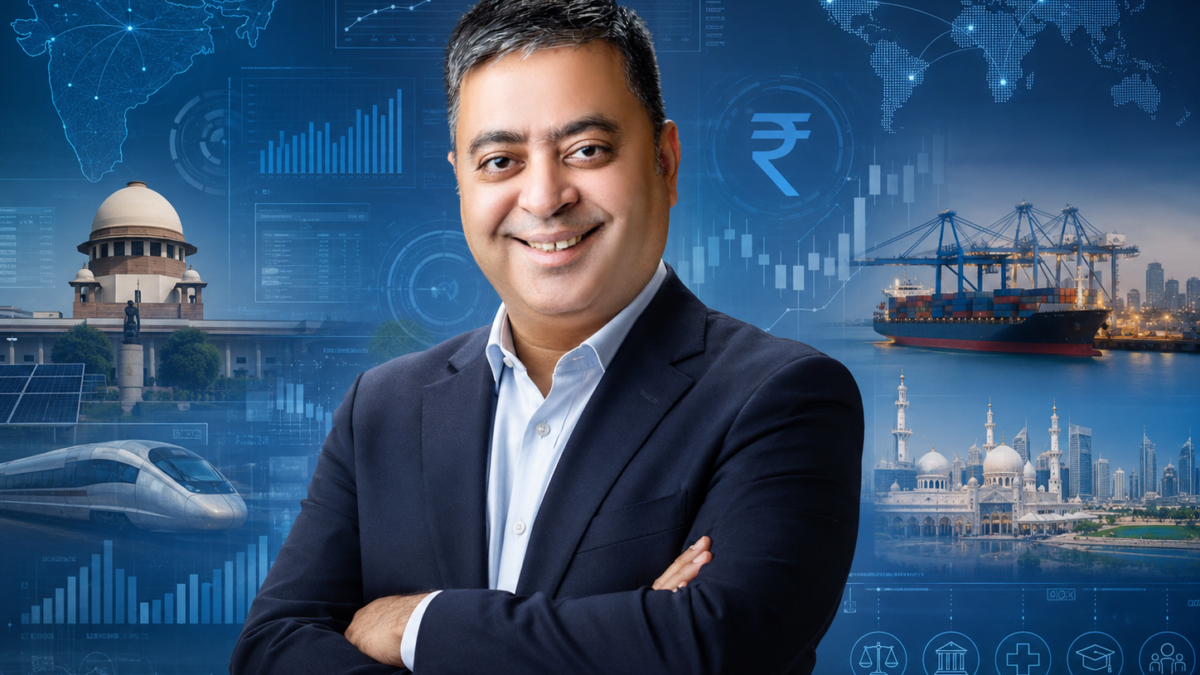

From JURISFLOW AI for justice to CorpVidesh AI for outbound capital and a Viksit Bharat 2047 roadmap for education, healthcare, markets and currency reform, Mukherjee’s work argues that India’s next leap will depend on auditable institutions, not slogans.
There are visions that remain rhetorical, and there are visions that try to become infrastructure. Raja Mukherjee’s recent body of work belongs to the second category.
Across a set of policy drafts, technical documents and editorial submissions, Mukherjee’s central argument is clear: India’s next development phase will not be won only by capital, technology or ambition in isolation. It will be won by building institutions that can turn these forces into reliable public and economic systems.
That is why his work moves across domains that may appear separate at first glance: judicial access, artificial intelligence, outbound capital, FEMA and LRS reform, GIFT City, rupee internationalisation, healthcare cities, Gurukul-AI education, India-Gulf investment corridors and ethical finance. The connecting thread is not subject matter. It is systems architecture.
Mukherjee’s vision asks a larger question: can India build its own sovereign operating systems for justice, capital, knowledge and global expansion?
The first pillar: justice as a technological public good
The most constitutionally ambitious part of Mukherjee’s work is JURISFLOW AI. In the Parliamentary Edition of the JURISFLOW AI thesis, the project is framed as a federated, voice-first and multilingual artificial-intelligence backbone for Indian justice, designed to serve citizens without replacing judges or advocates.
The project’s language is deliberate. It is not described as a legal chatbot. It is described as judicial infrastructure: citizen intake, document drafting, authenticated legal retrieval, bias-audited routing, public audit logs and human-in-the-loop safeguards.
This distinction matters. India does not need technology that merely generates legal text. It needs systems that make the legal process more reachable, more understandable and more verifiable for ordinary citizens. Mukherjee’s thesis connects this directly to the constitutional promise of Articles 14, 21, 39A and 50, arguing that access to justice must be operationalised, not merely declared.
The pipeline is simple in concept but demanding in execution: a citizen speaks, the system classifies the grievance, drafts a court-ready first pass, routes it through a bias-audited allocator and supports cryptographically verifiable bench assignment. The promise is not that artificial intelligence will decide cases. The promise is that it can remove procedural barriers that keep citizens away from judges.
The second pillar: India’s outbound capital needs a regulated rail
If JURISFLOW AI addresses procedural exclusion in justice, CorpVidesh AI addresses procedural friction in capital. The CorpVidesh AI proposal is positioned as an AI-powered cross-border capital RegTech platform for large Indian corporates and domestic institutions. Its core setting is GIFT City IFSC, and its core stakeholders are Indian corporates, authorised dealer banks, RBI, Ministry of Finance, IFSCA, SEBI and global execution venues.
The project argues that India’s outbound capital movement is too fragmented for the scale of corporate India’s global ambition. Overseas Direct Investment, Overseas Portfolio Investment, LRS flows, Form ODI, APR, FC reporting, 15CA and 15CB tax workflows, Section 195 checks, net-worth calculations and audit requirements are often handled across separate interfaces.
Mukherjee’s proposal is to make this a single regulated rail. It combines a FEMA compliance engine, dynamic 400% net-worth monitoring, OPI exposure controls, AML and KYC screening, GIFT-IFSC routing, Hyperledger audit trails and regulator dashboards.
For Economic Statesman, the interesting point is not whether every technical estimate will survive regulatory scrutiny. The interesting point is the institutional direction. Mukherjee is arguing that India’s outbound capital future should not mean less supervision. It should mean better supervision: live dashboards instead of ex-post reconciliation, audit hashes instead of document trails, and compliance logic embedded before capital moves.
| Layer | Main Components | Institutional Purpose |
|---|---|---|
| Presentation | Corporate treasury portal, regulator dashboard, CFO approvals, auditor view | Role-segregated visibility for companies, regulators and auditors |
| API & Orchestration | REST/GraphQL gateway, OAuth, Aadhaar eKYC, event bus, WAF and rate limiter | Secure and observable transaction coordination |
| AI / Compliance Core | FEMA engine, 400% net-worth monitor, AML/KYC scorer, FX and venue optimiser | Rule interpretation and risk validation before capital moves |
| Data & Integration | PostgreSQL ledger, Hyperledger audit chain, vector database and object store | Hot, cold and immutable records for traceability |
| Regulatory & External | RBI, MoF, IFSCA, SEBI, SWIFT, FX banks and global exchanges | Connection to sovereign and market rails |
The third pillar: knowledge, healthcare and the human-capital state
Mukherjee’s vision is not limited to courts and capital. A separate strand of his 2047 framework places education, healthcare and institutional capacity at the centre of national development. The recurring themes are Gurukul-AI campuses, engineering laboratories, a world-class affordable healthcare city, tertiary hospitals, medical tourism corridors, livelihood-linked skilling and knowledge hubs.
This is where his civilisational language meets development economics. The argument is that India does not need to choose between its knowledge traditions and modern technology. It can build an educational model that combines Vedic learning, AI tutors, robotics, multilingual access, frontier science and practical employability.
In healthcare, the vision imagines large-scale hospital and medical-education infrastructure connected to regional patient flows and international partnerships. The proposed 10,000-bed affordable healthcare city and wider target of tertiary-care capacity are best read as vision-led institutional proposals, not as completed facts. But their strategic meaning is clear: human capital must be built through institutions, not speeches.
| Institutional Element | What It Builds | Economic Statesman Reading |
|---|---|---|
| Gurukul-AI campuses | Ethics-led learning, AI tutors, robotics and multilingual knowledge access | A civilisational education model adapted to future skills |
| Knowledge engineering hubs | Applied learning, systems design and implementation capability | A pathway from ideas to execution capacity |
| Affordable healthcare city | Treatment, training, diagnostics, research and medical workforce development | Healthcare as infrastructure, not only service delivery |
| Engineering laboratories | Deep-tech experimentation, patents and applied research | The production layer behind innovation sovereignty |
| Livelihood and skilling platforms | Employability, practical training and youth pathways | The social bridge between growth and household income |
The fourth pillar: India-Gulf corridors and the geography of capital
Mukherjee’s India-Gulf framework is another important part of the vision. It reframes the Gulf not only as a destination for Indian labour, trade and diaspora wealth, but as a possible co-architect of India’s next development phase.
In this model, Dubai, Abu Dhabi and Riyadh become financial gateways. GIFT City becomes the regulated bridge. Gulf sovereign wealth funds, family offices and financial institutions become sources of patient capital. India becomes the scale market for healthcare, education, infrastructure, deep-tech, currency corridors and values-based finance.
This is a sophisticated shift. India-Gulf relations are often described through oil, remittances, construction, shipping and jewellery. Mukherjee’s frame adds capital markets, rupee settlement, private banking, medical tourism, education exports and ethical finance.
The 2047 frame: from targets to sequencing
The most ambitious part of the vision is its 2047 horizon. It connects education, healthcare, FDI, capital markets, rupee reform and global institutional positioning into a phased national story.
The point is not that every target should be accepted uncritically. Economic journalism must distinguish between proposals, plans, targets and implemented outcomes. The point is that Mukherjee’s framework attempts to sequence the future. It asks what India must build by 2030, what must scale by 2035, what must integrate by 2040 and what must consolidate by 2047.
For Economic Statesman, this sequencing is where the vision becomes investable. Investors, policymakers and institutional partners do not only need ambition. They need milestones, governance, risk controls and delivery logic.
| Pillar | Core Theme | Strategic Direction |
|---|---|---|
| Vedic + AI Education | Gurukul-AI, tutors, robotics and multilingual learning | Build future-ready citizens through Indian knowledge and frontier technology |
| Healthcare & Medical EduTech | Teaching hospitals, medical tourism and deep-tech labs | Turn healthcare into a regional capacity and investment platform |
| FDI & Industrial Capacity | Long-horizon capital, manufacturing and deep-tech corridors | Attract patient capital for infrastructure and productive capacity |
| Stock Market as Price-Setter | Deeper markets, wider listings and rupee-linked trading | Move India from capital recipient to benchmark creator |
| Rupee & Banking Reform | INR global trading, private banking and outbound capital liberalisation | Make Indian capital more global without losing regulatory trust |
The discipline missing from many grand visions
Grand visions are common in India. Institutional discipline is rarer. Mukherjee’s work is strongest when it recognises that technology without governance becomes risk, capital without audit becomes opacity, and civilisational confidence without delivery becomes decoration.
That is why the recurring vocabulary across his documents matters: federation, audit, human-in-the-loop, regulator dashboards, verifiable randomness, authenticated legal corpus, GIFT-IFSC, data residency, Hyperledger, FEMA Reasoner, compliance score, and statutory authority.
This is not the language of pure aspiration. It is the language of infrastructure.
| Design Principle | In Justice | In Capital | Why It Matters |
|---|---|---|---|
| Federation | Each court keeps institutional sovereignty | GIFT City, banks and regulators act within defined rails | Prevents over-centralisation while enabling coordination |
| Auditability | Routing and model actions leave public/verifiable records | Outbound capital movements create immutable audit trails | Builds trust without relying on personal assurances |
| Human-in-the-Loop | No binding judicial outcome is generated by AI | Escalation remains for high-risk transactions | Preserves institutional judgement and accountability |
| Multilingual Access | Citizens can enter the system in their own language | Compliance becomes machine-readable across stakeholders | Reduces exclusion and interpretation risk |
| Sovereign Technology | Justice data and authority remain constitutionally bounded | Indian capital globalises through supervised domestic infrastructure | Allows global reach without surrendering control |
The Economic Statesman view
Raja Mukherjee’s vision should not be read as one project, one article or one institutional pitch. It is a broader attempt to define how India can design systems for a larger role in the world.
At its core, the vision carries three propositions.
First, India must build sovereign-grade digital infrastructure in sectors where trust is non-negotiable: justice, capital movement, compliance, education and health.
Second, Indian tradition and modern technology need not be opposites. A country can draw from its civilisational memory while building with AI, cryptography, data governance, capital-market depth and international financial architecture.
Third, India’s global future must be institutionalised. It cannot depend only on charismatic leadership, isolated reforms or private ambition. It requires platforms, authorities, corridors, audit trails, regulator dashboards, educational systems, healthcare capacity and capital pathways.
Raja Mukherjee’s strongest idea is not that India needs more ambition. It is that India’s ambition must be converted into auditable, investable and sovereign systems.
Economic Statesman Editorial AnalysisThat is what makes the work notable. It belongs to the category of ideas that may be debated, refined, challenged and institutionalised. Some targets may change. Some architectures may require regulatory validation. Some claims may need independent verification. But the direction is significant.
India is entering a phase where the gap between ambition and execution will define the next generation of national power. The countries that lead will be those that build trusted systems: systems that move capital without opacity, deliver justice without exclusion, educate without deracination, heal at scale without reducing care to commerce, and participate globally without surrendering strategic agency.
Mukherjee’s vision is therefore best understood as a call for state-capable imagination. It asks India to think not only about growth rates, but about the operating systems that make growth durable. It asks investors to look not only at sectors, but at institutional rails. It asks policymakers to treat technology not as a press release, but as constitutional and economic infrastructure.
For a country that wants to move from scale to leadership, that distinction matters.
India has many dreams. The test now is whether it can build the systems that make them real.
This article is based on Raja Mukherjee’s JURISFLOW AI parliamentary thesis, CorpVidesh AI project proposal, FEMA/LRS reform material and 2047 vision documents supplied for editorial review. Project metrics, future targets and platform claims are treated as vision statements, proposal material or editorial analysis unless separately verified by public authorities or market participants.
Elena Marlowe
Elena Marlowe represents the Economic Statesman editorial desk for platform pages, standards and institutional information.