
Why Rupee Stability Matters for Investors
For global investors, India’s growth story is always read through the currency as well as the equity or bond market.
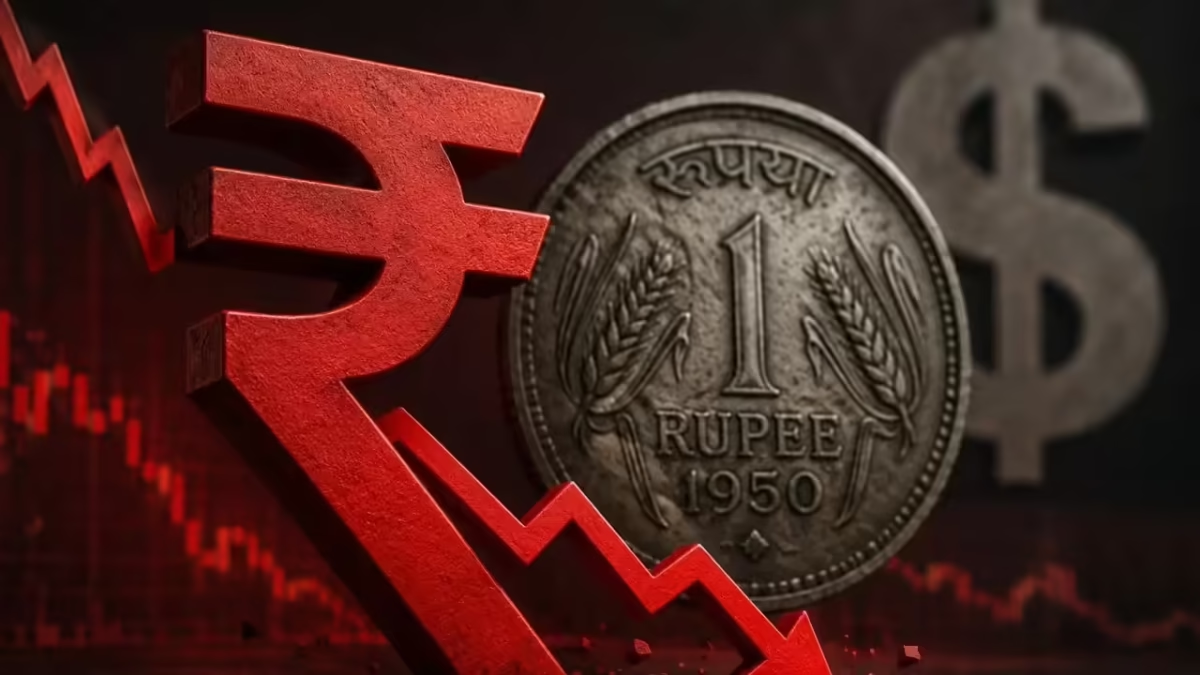

Rupee stability matters because India is no longer being assessed only as a large domestic market. It is being watched as a growth engine, a production base, a digital infrastructure model, a services exporter and a geopolitical swing economy. A strong domestic return can be reduced if the currency weakens sharply against the investor’s funding currency.
The scale of the opportunity is clear, but scale alone does not create economic power. What matters is the conversion of population, consumption, savings, enterprise and state capacity into durable productivity. Investors increasingly look at whether India can turn demand into manufacturing depth, digital adoption into formalisation, infrastructure spending into lower logistics costs and policy credibility into long-term capital inflows. Currency stability supports lower risk premia, more predictable imported inflation and stronger confidence in local-currency assets.
The policy challenge is therefore not simply to grow. It is to grow in a way that improves competitiveness. Tax administration, customs efficiency, power reliability, labour participation, skills, financial inclusion and urban capacity all influence whether growth becomes self-reinforcing. The central bank does not need to defend a fixed level to influence confidence; it can reduce disorderly volatility and maintain credible reserves.
Capital is central to this story. India attracts attention because global investors need exposure to economies where domestic demand, private enterprise and public investment can move together. Yet capital is selective. It rewards clarity, liquidity, governance and exit routes. If public markets, private markets and family offices deepen together, India’s role in global capital allocation becomes more credible.
The strategic reading
The global dimension is equally important. India’s currency is shaped by oil imports, capital flows, trade balances, rate differentials and global dollar strength. India’s relationships with the United States, Europe, the Gulf, Japan and Southeast Asia are no longer only diplomatic. They are investment, technology, energy, infrastructure and supply-chain relationships. This gives India optionality, but it also raises expectations.
There are constraints. Risks include sudden outflows, imported inflation, external shocks and excessive reliance on intervention. Infrastructure gaps, uneven state capacity, currency volatility, judicial delays, employment intensity and dependence on imported energy can all shape investor confidence. A serious reading of India’s rise must hold both sides of the story together: the momentum and the bottlenecks.
For companies, India cannot be treated as a single market. It is a continental economy with different state-level policies, consumer segments, industrial clusters and regulatory realities. A manufacturing investor in Tamil Nadu, a financial services firm in Mumbai, a technology company in Bengaluru and a logistics player in Gujarat may all be making India bets, but they are not making the same bet.
Rupee stability matters because it converts India’s domestic growth into investable returns for global capital. Credibility is measured not by a perfectly still currency, but by orderly adjustment. India’s economic importance is therefore not based on inevitability. It is based on execution. If policy credibility, infrastructure quality, private investment and institutional trust improve together, India can become one of the central economies of the next global cycle. If they diverge, the promise will remain large but uneven.
For Economic Statesman readers, the practical lesson is to treat the subject not as an isolated market event but as part of a wider system of policy credibility, capital allocation and institutional trust. The most useful analysis is rarely the loudest forecast. It is the disciplined reading of incentives, balance sheets, political constraints and time horizons that decide whether an economic signal becomes a durable trend or a temporary disturbance.
For Economic Statesman readers, the practical lesson is to treat the subject not as an isolated market event but as part of a wider system of policy credibility, capital allocation and institutional trust. The most useful analysis is rarely the loudest forecast. It is the disciplined reading of incentives, balance sheets, political constraints and time horizons that decide whether an economic signal becomes a durable trend or a temporary disturbance.
For Economic Statesman readers, the practical lesson is to treat the subject not as an isolated market event but as part of a wider system of policy credibility, capital allocation and institutional trust. The most useful analysis is rarely the loudest forecast. It is the disciplined reading of incentives, balance sheets, political constraints and time horizons that decide whether an economic signal becomes a durable trend or a temporary disturbance.
Julian Reed
Julian Reed covers monetary policy, central-bank communication, inflation targeting and the wider financial signals that move markets.