
How Sanctions Became a Tool of Economic Power
Sanctions have evolved from narrow diplomatic pressure into a major instrument of financial, trade and technological power.
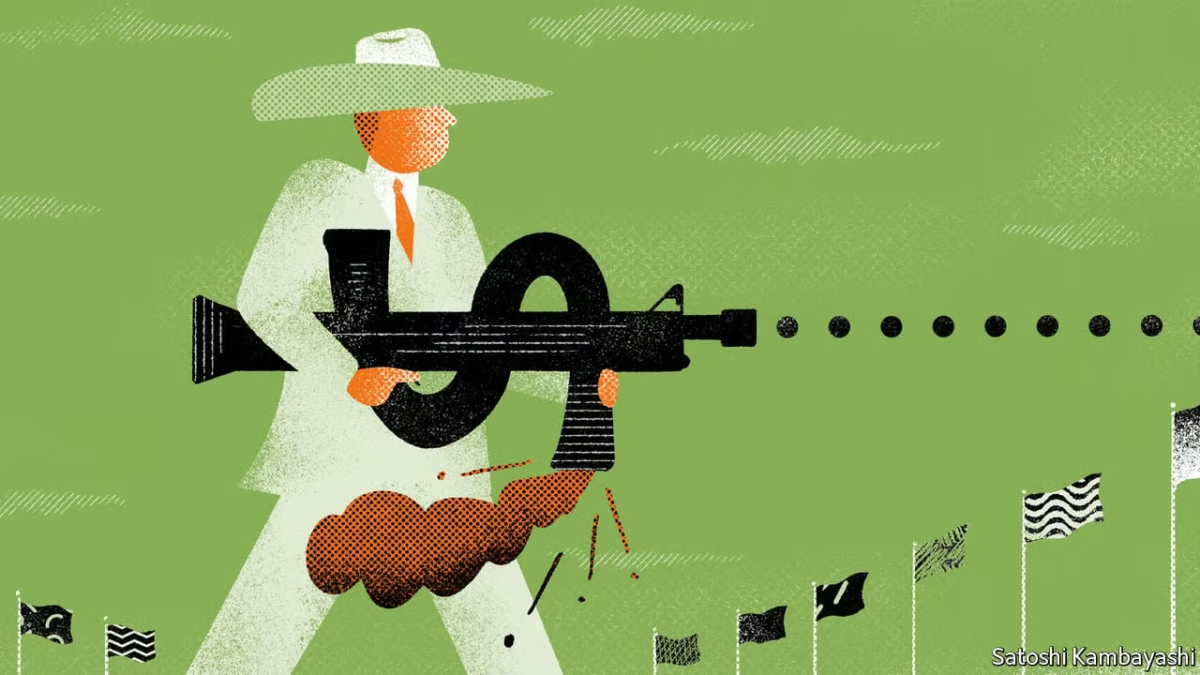

Sanctions were once seen mainly as a diplomatic signal: a way to show disapproval without sending troops. They still serve that function, but their role has expanded. In a world where finance, trade, insurance, shipping, payments and technology are deeply connected, sanctions can restrict access to the networks that make modern economic life possible. That is why they have become one of the most visible instruments of economic power.
The modern sanctions regime works because critical systems are interconnected. Banks need correspondent relationships. Shipping depends on insurance, classification and port access. Companies rely on software updates, components and financing. States need foreign currency, bond markets and payment channels. When a sanctioned actor is cut off from these networks, the damage is not limited to one transaction. It can spread across supply chains, credit relationships and strategic industries.
Financial sanctions are especially powerful because the dollar-based system remains central to global trade and finance. A country or company may not operate in the United States, but it can still be affected if its banks, suppliers or insurers need access to dollar clearing or US-linked financial institutions. This gives sanctions a reach that goes beyond national borders. It also explains why many governments and companies spend heavily on compliance systems to avoid accidental exposure.
Trade and technology sanctions have become more important as strategic competition has moved into advanced industry. Restrictions can target energy equipment, dual-use goods, semiconductors, aerospace components, defence technologies or software. The aim is not only to punish behaviour but to limit future capacity. If a country cannot access advanced chips, machine tools or specialist services, its military and industrial development may slow. Sanctions therefore operate in time: they pressure the present and try to shape the future.
The effect is rarely clean. Sanctions can impose costs, but they can also create adaptation. Targeted states may build alternative payment channels, redirect trade, use intermediaries or deepen relationships with non-sanctioning partners. Companies may reroute supply chains through third countries. Over time, sanctions can encourage the very fragmentation they are designed to exploit. This does not make them ineffective, but it means their impact depends on coalition strength, enforcement quality and the availability of substitutes.
For businesses, sanctions risk is no longer confined to banks or defence contractors. A logistics provider, software company, commodity trader, insurer, consultancy or manufacturer can become exposed through a customer, subsidiary, distributor or supplier. The key issue is beneficial ownership and end use. Who ultimately controls the counterparty? Where does the product end up? Could a service support a restricted sector? These questions now belong in boardrooms, not only legal departments.
For governments, sanctions raise a strategic dilemma. They are attractive because they offer a non-military form of pressure. They can be imposed quickly and scaled across finance, trade and technology. Yet overuse can encourage other countries to build parallel systems and reduce dependence on sanctioning powers. The long-term strength of sanctions depends not only on legal authority but also on the continued centrality of the networks being used as leverage.
For companies and investors, the practical lesson is to build a political-economy map around every important market. That map should identify suppliers, customers, financing sources, technology dependencies, regulatory permissions and public-sector relationships. Economic statecraft rarely arrives as a single dramatic measure. It usually appears through licensing rules, procurement preferences, customs enforcement, investment screening, bank compliance and changes in official language.
The stronger organisations will not treat these developments as temporary interruptions. They will make them part of strategy, treasury, legal review and market-entry planning. That does not mean retreating from global business. It means understanding that in sensitive sectors, commercial advantage can disappear if political access, technology permissions or trusted supply are lost. In this environment, resilience is not a slogan; it is a form of competitiveness.
The editorial test for any claim in this area is evidence. Before publication, every reference to a tariff, sanction, export-control rule, subsidy, corridor or investment-screening measure should be checked against official releases, legal texts or institutional reports. The argument can be analytical, but the factual base must remain precise.
What to watch next
The next stage of sanctions policy will be shaped by enforcement, secondary sanctions, technology controls and the response of non-aligned economies. Watch shipping registries, insurance markets, commodity flows, bank compliance actions and export-control coordination. The headline sanction is only the beginning. The real test is whether the measure changes behaviour, restricts capacity or merely changes the route through which activity continues. Sanctions are powerful because the global economy is connected; they are complicated for exactly the same reason.
Marcus Vane
Marcus Vane covers economic statecraft, sanctions, tariffs, industrial policy and the strategic use of economic power.