How Aviation Became a Middle East Economic Strategy
Middle East aviation is no longer only about airlines; it is a national strategy for connectivity, tourism, logistics and economic positioning.
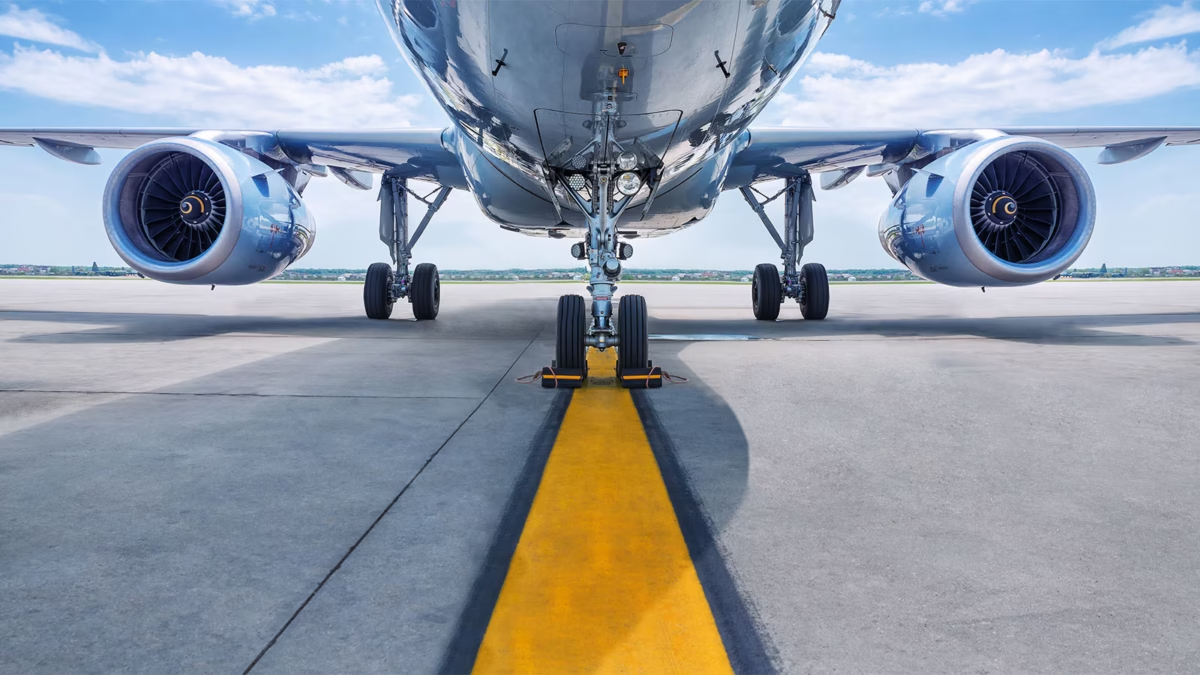

Aviation in the Middle East is often judged by aircraft orders, airport terminals and the global visibility of Gulf airlines. But the strategic significance is wider. Aviation has become an economic development tool. It connects tourism, logistics, labour mobility, business travel, cargo, national branding and foreign investment. For countries seeking to diversify beyond oil and gas, airlines and airports are not merely transport assets. They are platforms that bring people, capital and commerce into the economy.
The Gulf’s aviation model emerged from geography. The region sits between Europe, Asia and Africa, allowing airlines to connect long-haul traffic through hub airports. Dubai turned this geography into a global aviation business with Emirates and Dubai International. Qatar built a similar connectivity proposition around Qatar Airways and Doha. Abu Dhabi used Etihad as part of a broader national positioning strategy. Saudi Arabia is now placing aviation at the centre of its tourism and logistics ambitions through new investment, airports and carriers such as Riyadh Air.
The economic logic is simple but powerful. A country that becomes easier to reach becomes easier to invest in, visit and trade with. Airlines bring tourists to hotels, delegates to conferences, executives to headquarters, workers to labour markets and cargo to logistics networks. Airport expansion creates construction activity, service employment and commercial real estate. Aviation therefore multiplies across sectors. Its value is not confined to airline profit and loss accounts.
Tourism is one of the most visible channels. Saudi Arabia’s tourism goals require direct connectivity from major source markets. The UAE’s hospitality and events economy depends on high-frequency air links. Qatar’s global events strategy relies on the same principle. Without aviation, tourism campaigns remain limited by access. With aviation, a destination can shape demand by opening routes, partnering with tour operators and building stopover traffic.
Connectivity as development infrastructure
Cargo and logistics are equally important. Air freight supports high-value goods, pharmaceuticals, electronics, e-commerce and time-sensitive supply chains. When paired with seaports, free zones and customs systems, aviation helps create a trade ecosystem. This is why airports in the region are often linked to logistics parks and special economic zones. The aim is not just to move passengers but to control more of the value chain around trade and distribution.
Aviation also carries soft power. A national airline is a flying brand. It shapes how business travellers, tourists and investors experience a country before they arrive. Cabin service, route maps, sponsorships and airport design all become part of national image-making. This soft-power function is not superficial. In a competitive region, brand familiarity can influence tourism, conferences, talent attraction and investor perception.
The strategy comes with risks. Airlines are capital-intensive, cyclical and exposed to fuel prices, geopolitical disruption, pandemics and competition. Large aircraft orders can create pressure if demand underperforms. Airports can become overbuilt if passenger forecasts prove too optimistic. State-backed aviation strategies must therefore balance ambition with route economics, operational efficiency and realistic tourism development. Connectivity is valuable only when it connects to real demand.
There is also regional competition. Multiple Gulf states are building or expanding aviation ecosystems at the same time. Not every hub can dominate the same routes, passengers and cargo flows. Differentiation will matter. Dubai has scale and maturity; Doha has premium positioning; Abu Dhabi has integration with sovereign capital and tourism; Saudi Arabia has domestic scale and religious tourism alongside new leisure ambitions. The region’s aviation future may be less about one dominant hub and more about specialised networks.
Aviation became a Middle East economic strategy because connectivity is now a form of economic infrastructure. The countries that move people, goods and capital efficiently can shape regional flows. For the Gulf, airlines and airports are therefore part of diversification, statecraft and global positioning. The runway is not just a strip of concrete. It is an economic corridor.
For Economic Statesman readers, the useful test is not whether the headline idea sounds attractive, but whether the underlying institutions, capital discipline and execution capacity can sustain it. Markets eventually separate durable structural change from temporary policy momentum. That is why the subject should be read through evidence, sequencing and incentives rather than through promotional language or short-term sentiment.
For Economic Statesman readers, the useful test is not whether the headline idea sounds attractive, but whether the underlying institutions, capital discipline and execution capacity can sustain it. Markets eventually separate durable structural change from temporary policy momentum. That is why the subject should be read through evidence, sequencing and incentives rather than through promotional language or short-term sentiment.
Marcus Vane
Marcus Vane covers economic statecraft, sanctions, tariffs, industrial policy and the strategic use of economic power.