
How Trade Fragmentation Is Rewriting the Global Economy
Trade fragmentation is not the end of globalisation. It is the rewriting of global commerce around risk, resilience, political alignment and strategic control.
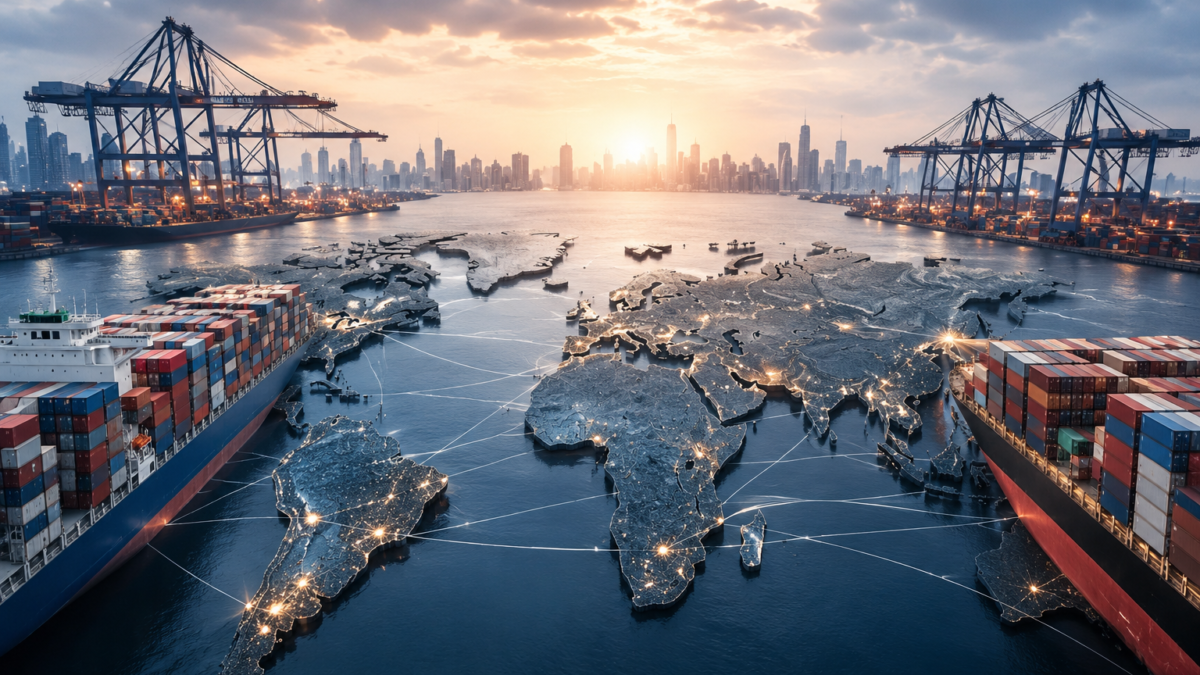

Global trade is not collapsing, but it is becoming more political, more regional and more security-driven as governments move from pure efficiency to managed resilience.
Global trade is not disappearing. It is being rewritten.
For three decades, the dominant logic of globalisation was efficiency. Companies searched for the lowest-cost production base, governments welcomed open supply chains, and investors rewarded scale, speed and margin. The assumption was simple: if goods could move cheaply across borders, the world economy would become more productive and more integrated.
That assumption has not vanished, but it no longer stands alone. Trade is now being judged through a second lens: security. Governments are asking where critical goods are made, who controls shipping routes, which economies dominate key inputs, and whether national prosperity can depend too heavily on suppliers located inside geopolitical rival blocs.
This is the real meaning of trade fragmentation. It does not mean that countries have stopped trading. It means that trade is becoming conditional. More of it is shaped by tariffs, sanctions, export controls, investment screening, preferential agreements, national-security reviews and industrial policy.
The World Trade Organization’s latest analysis shows how quickly the rules environment is shifting. According to WTO reporting, the share of world trade conducted under most-favoured-nation treatment fell from around 80% in 2024 to roughly 72% by early 2026, reflecting the spread of tariff actions and the growing use of preferential agreements. The WTO also forecast that global merchandise trade growth would slow to 1.9% in 2026 after 4.6% growth in 2025.
The world is moving from efficiency to resilience
The old trade map was built around cost. The new trade map is being built around exposure.
A company that once asked “Where can we make this most cheaply?” now has to ask a longer question: Can we still receive this component during a crisis? Could sanctions affect this supplier? Will customs rules change? Could shipping costs spike? Will political pressure force production closer to home? Could a government suddenly restrict exports of a critical input?
This does not always mean production returns home. In many cases, it moves sideways. Supply chains shift from one foreign location to another foreign location that is seen as less risky. This is why terms such as nearshoring, friendshoring and China-plus-one have become part of boardroom language. Companies are not abandoning global supply chains. They are redesigning them with redundancy, optionality and political risk in mind.
The result is a more complicated form of globalisation. A product may still cross several borders before reaching the consumer, but those borders are increasingly selected for political compatibility as well as commercial efficiency.
This matters because resilience is not free. Duplication costs money. Alternative suppliers may be less efficient. Regional production may reduce some risks while increasing others. Inventory buffers protect companies during disruption but tie up capital. In a world of fragmented trade, the price of security becomes part of the price of goods.
Tariffs are no longer only economic tools
Tariffs were once discussed mainly as instruments of protection or bargaining. Today, they are also instruments of economic statecraft.
A tariff can protect domestic producers, but it can also signal political pressure, punish a rival, reshape investment decisions or force companies to reconsider supply chains. The same applies to export controls. When governments restrict the export of advanced chips, critical minerals, defence-linked technologies or dual-use equipment, they are not merely regulating trade. They are shaping the technological balance of power.
Sanctions have similar consequences. They can isolate a state, redirect commodity flows, alter banking relationships and create new intermediaries. When sanctions become a recurring tool of policy, companies begin to treat compliance not as a legal department issue but as a strategic operating condition.
This is where trade fragmentation becomes structural. Once companies believe that political shocks are permanent rather than temporary, they change capital allocation. Factories are built in different places. Warehousing strategies change. Supplier contracts become more complex. Governments begin subsidising sectors once left to market forces.
The global economy does not break in one moment. It bends through thousands of corporate and policy decisions.
Connector economies are gaining importance
One of the most important effects of trade fragmentation is the rise of connector economies.
These are countries that sit between major blocs and benefit from supply-chain rerouting. They may receive new investment because companies want access to one large market without being fully exposed to another. They may become assembly hubs, logistics centres, financial intermediaries or manufacturing bridges.
The IMF has noted that connector countries, including economies such as Mexico and Vietnam, have helped cushion the impact of direct trade decoupling between the United States and China. In the same discussion, IMF First Deputy Managing Director Gita Gopinath warned that the economic cost of deeper fragmentation could range from small losses in mild scenarios to as much as 7% of global GDP in an extreme scenario with limited adjustment capacity.
That range is important. Fragmentation is not a single outcome. It can be managed or it can become destructive. If countries diversify suppliers while keeping trade broadly open, the cost may be contained. If the world splits into hostile blocs with restricted technology, capital and goods flows, the cost could become much larger.
For emerging economies, this creates opportunity and risk. Countries that can offer policy stability, infrastructure, skilled labour and diplomatic balance may attract new investment. Countries that are seen as politically exposed, logistically weak or institutionally unreliable may be bypassed.
The WTO system is under pressure, not irrelevant
It is tempting to say that the WTO era is over. That would be too simple.
The WTO remains central because even a fragmented world needs rules. Countries still need dispute frameworks, tariff schedules, transparency systems, trade data and negotiation platforms. The problem is not that multilateral trade rules have no value. The problem is that major economies are increasingly willing to work around them when national-security or domestic political priorities dominate.
The WTO’s 2023 World Trade Report argued for “re-globalization” rather than fragmentation, making the case that wider and more inclusive trade remains a better answer to global challenges than retreating into blocs.
That argument remains relevant. Fragmentation can make supply chains more secure in the short term, but it can also reduce competition, raise costs, weaken smaller economies and make global cooperation harder. Climate transition, food security, pandemic preparedness and financial stability all require cross-border coordination. A world that fragments too far may become less resilient, not more.
What businesses must understand now
For companies, the most dangerous mistake is to treat trade policy as background noise.
Trade rules now affect valuation, sourcing, investment, pricing and strategy. A company exposed to politically sensitive inputs must understand not only its first-tier suppliers but also deeper supply-chain dependencies. A manufacturer must know whether its components pass through vulnerable ports or jurisdictions. A technology company must monitor export-control rules. An investor must judge whether a promising market is gaining from fragmentation or merely enjoying a temporary rerouting effect.
The new corporate advantage is not only cost efficiency. It is geopolitical literacy.
Boards need to ask sharper questions. Where are our critical suppliers? Which governments could disrupt them? What happens if tariffs rise? Can we shift production without destroying margins? Are we over-dependent on one country, one shipping route or one regulatory regime? Do we understand the political risk inside our logistics map?
These questions used to belong to diplomats and trade lawyers. They now belong to CEOs, CFOs and investors.
The Economic Statesman view
Trade fragmentation is not the end of globalisation. It is the politicisation of globalisation.
The world economy will continue to trade because no major economy can produce everything it needs at competitive scale. But the confidence that once made supply chains feel neutral has weakened. Governments now see trade as a strategic vulnerability as much as an engine of prosperity.
The next phase of global trade will therefore be less elegant, less frictionless and more strategic. It will reward countries that combine openness with resilience. It will reward companies that understand political risk before it appears in earnings. It will reward investors who can distinguish between temporary trade diversion and durable economic realignment.
The question is no longer whether global trade will continue. It will. The deeper question is who will write the new rules, who will absorb the costs and who will benefit from the map being redrawn.
Marcus Vane
Marcus Vane covers economic statecraft, sanctions, tariffs, industrial policy and the strategic use of economic power.