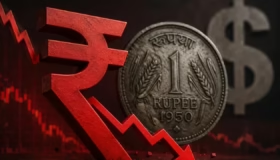
The Rupee’s Recovery Puts the RBI in a New Policy Dilemma
The rupee’s recovery to a six-month high gives India some currency relief, but the RBI faces a delicate balance between reserve rebuilding and exchange-rate stability.

The Indian rupee’s recent recovery has brought a different challenge into focus for the Reserve Bank of India (RBI). After facing sustained pressure and approaching record-low levels, the currency has strengthened sharply, reaching a six-month high of ₹93.70 against the US dollar on November 9. The improvement offers some relief to importers and reflects better conditions in the foreign-exchange market. However, it also raises a policy question: how much appreciation should the central bank allow before stepping in to rebuild its reserves?
The rupee gained more than 1 per cent last week and has appreciated by approximately 3.25 per cent over the past month, according to Reuters. The recovery has been supported by softer crude oil prices, renewed foreign investment in Indian equities and measures taken by the RBI to ease the imbalance between dollar demand and supply.
For an economy that imports a substantial share of its energy requirements, a stronger rupee can reduce the domestic cost of crude oil and other dollar-denominated imports. It can also moderate imported inflation by making foreign goods and commodities relatively less expensive in rupee terms. Businesses with significant import requirements may benefit from lower currency-related costs, while companies carrying unhedged foreign-currency liabilities could experience some relief.
Yet, a stronger exchange rate is not automatically an unqualified advantage. Exporters earning revenue in dollars may receive fewer rupees when converting their overseas earnings. A rapid appreciation can also affect the price competitiveness of Indian goods and services in international markets, particularly for businesses operating with narrow margins.
Why the RBI’s Reserve Position Matters
The central bank’s foreign-exchange reserves are a critical buffer against external shocks. They help meet international payment requirements, support confidence in the economy and provide the RBI with the capacity to address disorderly movements in the currency market.
Reuters reported that India’s foreign-exchange reserves had declined by around $68 billion from their peak. It also highlighted the RBI’s net short-dollar forward position, which reached nearly $240 billion in September. These forward commitments represent future dollar obligations and form an important part of the central bank’s overall foreign-exchange position.
The figures make reserve management more complicated. If the RBI purchases dollars when inflows are strong, it can add to its reserve holdings and potentially moderate the pace of rupee appreciation. However, such purchases also involve supplying rupees into the domestic financial system unless the resulting liquidity is absorbed through other operations.
The central bank must therefore consider both currency stability and domestic liquidity conditions. Its decisions cannot be based solely on whether the rupee is gaining or losing value on a particular trading day.
The Role of Crude Oil and Foreign Investment
Two external factors have played an important role in the recent currency recovery: energy prices and capital flows.
Lower crude oil prices can reduce India’s dollar requirements for energy imports, easing one of the major sources of demand in the foreign-exchange market. This is particularly significant because changes in oil prices can influence the import bill, current-account balance and inflation outlook simultaneously.
Foreign investment has also supported the rupee. Renewed inflows into Indian equities increase the supply of foreign currency in the domestic market when overseas investors convert dollars into rupees to purchase local assets. However, portfolio flows can change quickly in response to global interest rates, market valuations and investor risk appetite.
This makes the recent improvement encouraging but not necessarily permanent. A renewed rise in crude prices, a shift in global investment sentiment or stronger demand for the US dollar could reverse some of the gains.
Why a Stable Rupee Matters More Than a Specific Level
The RBI’s exchange-rate approach has traditionally focused on limiting excessive volatility rather than defending a fixed rupee-dollar level. This distinction is important for understanding its possible response to the current rally.
Allowing market forces to determine the exchange rate gives the currency room to adjust to changes in trade, investment and global financial conditions. At the same time, excessive and disorderly movements can create uncertainty for importers, exporters, investors and companies with foreign-currency exposure.
A gradual appreciation supported by stronger fundamentals may be easier for businesses to manage than a sudden currency swing. Similarly, a controlled depreciation can be less disruptive than a sharp decline that raises hedging costs and unsettles financial markets.
The RBI’s immediate priority may therefore be to manage the pace of the rupee’s movement while preserving adequate foreign-exchange buffers. If dollar inflows remain supportive, the central bank could use the opportunity to replenish reserves rather than allow the currency to appreciate without interruption. This remains a market expectation, not a confirmed announcement of a new intervention programme.
What Businesses and Investors Should Watch
The next phase of the rupee’s movement will depend on several indicators. Crude oil prices will remain important because they influence India’s import demand for dollars. Foreign portfolio investment will provide clues about international confidence in Indian assets, while the RBI’s reserve position and forward-market exposure will help investors assess the central bank’s room for manoeuvre.
Import-dependent companies may benefit if the rupee remains stronger, although businesses should not assume that current exchange-rate gains will continue. Exporters, meanwhile, may need to pay closer attention to currency hedging and pricing strategies to protect their margins.
For investors, the distinction between a temporary currency rally and a sustained improvement in external fundamentals will be particularly important. A stronger rupee can support sentiment, but it does not independently resolve the structural pressures associated with the current-account balance, energy dependence or volatile global capital flows.
India’s currency recovery has therefore shifted the RBI’s immediate challenge. The question is no longer only how to contain depreciation, but also how to use improved market conditions to strengthen external buffers without creating unnecessary volatility. The central bank’s ability to balance these objectives will influence the rupee’s stability and the wider economy’s resilience to global financial shocks.
Helena Strauss
Helena Strauss writes on energy markets, commodities, climate finance and the industrial policy choices behind energy security.