How Trade Corridors Become Instruments of Economic Power
Trade corridors are becoming strategic economic assets. Explore how global shipping routes, infrastructure investment and connectivity initiatives influence international trade and geopolitical relationships.
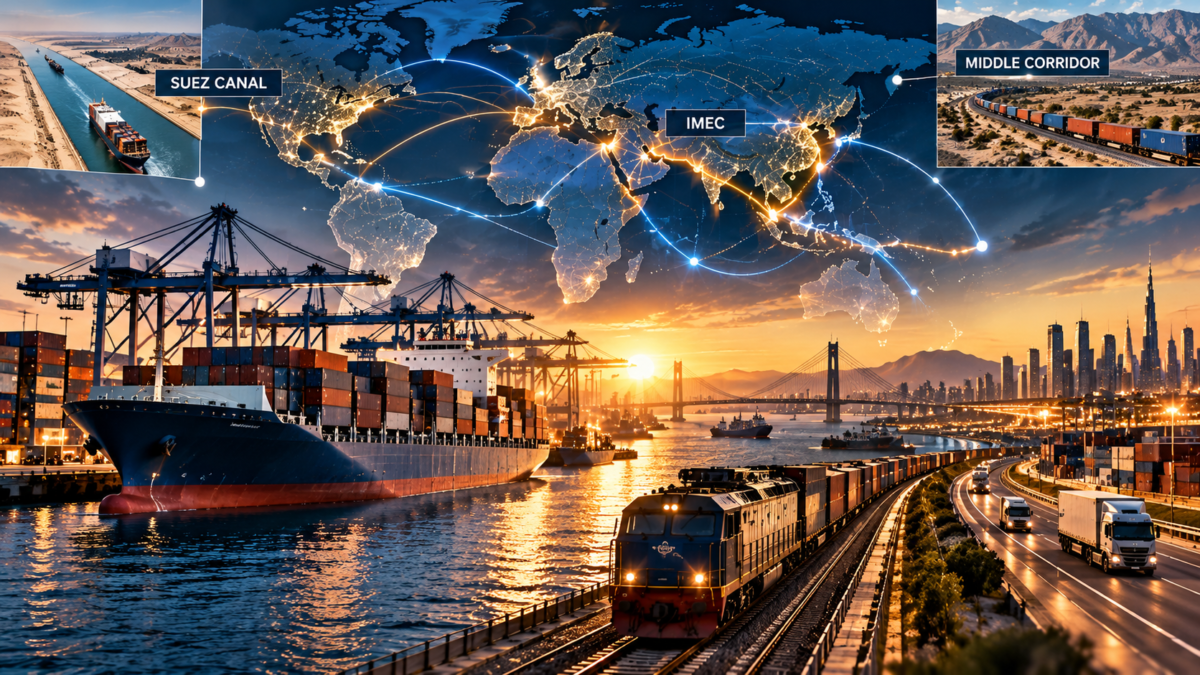

How shipping routes, logistics infrastructure and strategic connectivity are reshaping global trade and geopolitical relationships.
Trade routes have always influenced the distribution of economic power. Historically, control over ports, waterways and commercial passages helped determine which nations could access markets, secure resources and influence international commerce. Today, the same strategic importance remains, but the infrastructure has become more complex. Modern trade corridors connect seaports, railways, highways, inland logistics hubs, energy networks and digital systems into integrated economic routes.
These corridors do more than move goods. They influence transportation costs, supply-chain security, investment decisions and the economic relationships between countries. As governments compete to strengthen connectivity and reduce dependence on vulnerable routes, trade infrastructure is increasingly becoming an instrument of economic and geopolitical strategy.
Why Trade Corridors Matter to the Global Economy
A trade corridor is a connected network of transportation and logistics infrastructure that allows goods, services and resources to move between production centres and markets. It may include shipping lanes, ports, railway systems, highways, border facilities and customs infrastructure.
The efficiency of these networks directly affects the cost and reliability of international trade. Delays at ports, inefficient customs procedures, inadequate railway capacity or limited road connectivity can increase transportation expenses and disrupt production schedules.
For businesses operating across multiple countries, predictable logistics are essential. A reliable corridor can reduce delivery times, improve access to suppliers and help manufacturers reach new markets.
The World Bank’s September 2026 assessment of the Trans-Caspian Transport Corridor illustrates the economic potential. It estimates that targeted infrastructure investment and policy reforms could more than triple trade volumes along the route, halve travel times, increase GDP by 3.3% and create two million additional jobs by 2040.
The findings demonstrate that the value of a corridor depends not only on physical infrastructure but also on how effectively countries coordinate transport systems, regulations and border procedures.
Geography Creates Strategic Advantages
Some trade corridors become strategically important because of their geographical position.
The Suez Canal, for example, connects the Mediterranean Sea with the Red Sea and provides a major maritime passage between Europe and Asia. The Panama Canal connects the Atlantic and Pacific Oceans, while the Strait of Malacca remains a critical passage for shipping between the Indian Ocean and the Pacific.
Countries located near these routes can gain advantages through port services, shipping infrastructure, logistics investment and commercial activity.
However, geographical importance also creates vulnerability. When a major passage is disrupted, shipping companies may need to reroute vessels over longer distances. This increases fuel consumption, insurance costs, delivery times and freight expenses.
UN Trade and Development has documented how disruptions affecting the Red Sea, Suez Canal and Panama Canal have exposed weaknesses in global maritime supply chains. Longer routes have affected delivery schedules and increased pressure on businesses and economies dependent on international shipping.
The lesson is clear: a strategically located corridor can create economic opportunities, but dependence on a limited number of routes can also expose countries to external shocks.
Infrastructure as a Tool of Geopolitical Influence
Trade corridors can strengthen the influence of countries that finance, develop, operate or provide access to important infrastructure.
Investment in ports, railways and highways can deepen economic relationships between participating countries. It can also create long-term commercial dependencies through transport agreements, financing arrangements, operating contracts and shared logistics systems.
China’s Belt and Road Initiative is one of the most prominent examples of infrastructure-led international connectivity. Through investments and partnerships involving transport, energy and logistics infrastructure, China has expanded its economic engagement across Asia, Africa, Europe and other regions.
Such projects can improve connectivity and create opportunities for participating economies. At the same time, they raise questions about financing sustainability, project transparency, strategic dependence and the distribution of economic benefits.
The geopolitical significance of infrastructure therefore depends on more than who builds it. Ownership, financing terms, operational control, access rights and the ability to maintain alternative routes all influence the balance of power.
The Middle Corridor and Europe’s Search for Alternatives
The Trans-Caspian Transport Corridor, commonly known as the Middle Corridor, connects China and other East Asian markets with Europe through Central Asia, the Caspian Sea, the South Caucasus and Türkiye.
Its strategic importance has increased as governments and businesses seek alternatives to established trade routes. The corridor offers an additional connection between Asia and Europe, potentially improving supply-chain flexibility and reducing reliance on individual transit networks.
However, its expansion requires substantial investment. The World Bank estimates that countries along the route will need at least $25 billion in physical infrastructure investment through 2040, alongside approximately $30 billion in enabling investments such as logistics hubs, connecting roads, inland terminals and digital systems.
The corridor also faces practical challenges involving railway capacity, port operations, border procedures and coordination between different transport operators.
Its long-term competitiveness will depend on whether participating countries can create a genuinely integrated system rather than a collection of disconnected infrastructure projects.
India’s Connectivity Strategy and the IMEC Initiative
India’s geographical position gives it an important role in trade between South Asia, the Gulf region, Europe and Africa. As the country expands its manufacturing ambitions and international commercial partnerships, connectivity infrastructure has become an increasingly important element of its economic strategy.
The India-Middle East-Europe Economic Corridor (IMEC), announced during the G20 Summit in New Delhi in September 2023, is intended to strengthen connectivity between India, the Middle East and Europe.
The initiative brings together India, the United States, the European Union, Saudi Arabia and the United Arab Emirates, alongside European partners including France, Germany and Italy. Its proposed structure combines maritime connections with railway infrastructure and associated logistics networks.
For India, the initiative represents an opportunity to deepen trade relationships, improve access to international markets and strengthen its position in global supply chains.
In 2026, India and Italy reaffirmed their commitment to the corridor and encouraged the first IMEC ministerial meeting to take concrete steps towards advancing the initiative. They also welcomed cooperation on maritime transport and ports.
Nevertheless, IMEC should be understood as a developing connectivity initiative rather than an already completed trade route. Its implementation depends on infrastructure development, financing, regional cooperation and the ability to address political and security challenges across participating regions.
Why Supply-Chain Resilience Is Becoming a Priority
Recent disruptions have encouraged governments and companies to reconsider how much they depend on individual shipping routes and logistics networks.
A company relying on a single port or maritime passage may face significant operational difficulties when that route becomes unavailable. Delays can affect inventory management, production schedules and the delivery of finished goods.
As a result, businesses are increasingly interested in diversified sourcing, alternative shipping routes, regional manufacturing networks and additional logistics capacity.
Trade corridors can support this transition by creating more options for moving goods. However, diversification requires investment and coordination. An alternative route is only useful if it offers sufficient capacity, reliable services, competitive costs and predictable border procedures.
Governments also need to consider digital connectivity. Shared customs systems, interoperable documentation and real-time cargo information can improve corridor efficiency without requiring every improvement to come from large construction projects.
The Economic Risks of Corridor Competition
Although strategic connectivity can generate economic benefits, corridor development also involves significant risks.
Large infrastructure projects require substantial capital and long-term financial commitments. If projected trade volumes fail to materialise, governments and investors may face repayment pressures and underused assets.
Political disagreements can also delay projects. Trade corridors often cross several national jurisdictions, making them dependent on cooperation over customs procedures, transit rights, security arrangements and infrastructure standards.
There is also the risk of concentrating economic influence in the hands of a small number of infrastructure operators or transit countries. Excessive dependence on a single corridor can create vulnerabilities similar to those associated with dependence on a single shipping chokepoint.
Successful corridor planning must therefore balance strategic ambition with commercial viability, transparent financing and regional cooperation.
Trade Connectivity Will Shape the Next Phase of Global Competition
The future of global trade will not be determined solely by tariff agreements or the size of national economies. It will also depend on the physical and digital networks connecting producers, suppliers and consumers.
Countries that develop reliable ports, efficient railways, competitive logistics services and coordinated customs systems can strengthen their position in international commerce. Those that combine infrastructure investment with regional cooperation may attract manufacturing, encourage private investment and improve access to new markets.
Trade corridors are therefore becoming more than transportation projects. They are instruments through which countries build economic partnerships, diversify supply chains and expand strategic influence.
Their lasting value, however, will depend on whether they deliver measurable benefits to businesses and communities. A corridor becomes an instrument of sustainable economic power not simply when it connects two locations, but when it creates reliable trade, productive investment and shared economic opportunity.
Marcus Vane
Marcus Vane covers economic statecraft, sanctions, tariffs, industrial policy and the strategic use of economic power.