
India Approves 12 Electronics Projects Worth ₹7,503 Crore as Semicon 2.0 Portal Opens
Twelve new ECMS approvals and the Semicon 2.0 portal mark India's push to expand domestic electronics components and semiconductor manufacturing.
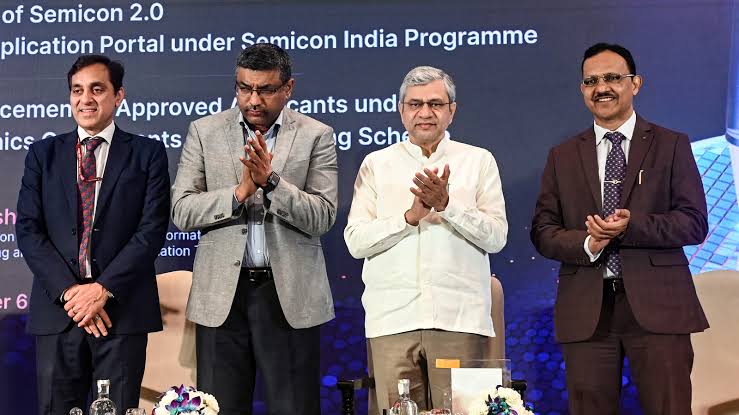

India is moving to strengthen the foundations of its electronics and semiconductor industry, shifting its manufacturing strategy beyond final assembly towards components, industrial materials and production equipment. The latest government approvals underline this change, with 12 additional projects receiving support under the Electronics Components Manufacturing Scheme (ECMS).
Announced by the Ministry of Electronics and Information Technology on November 6, the projects involve proposed investments of ₹7,503 crore. They are expected to generate production worth ₹39,045 crore and create 7,127 direct jobs. The announcement coincided with the launch of the Semicon 2.0 web application portal, opening applications for three strategic areas of the semiconductor programme.
Together, the developments reflect a broader policy objective: building more of the electronics value chain within India rather than relying heavily on imported components, materials and manufacturing equipment.
New Projects Target Critical Gaps in the Supply Chain
The 12 approved applications cover 10 product segments, including printed circuit boards, relays, heat sinks, specialty ceramics, copper foil, battery materials, polypropylene film, camera rims and capital goods.
The approvals are significant because several of these products serve as upstream inputs for larger manufacturing industries. Copper foil, for example, is used in printed circuit boards and lithium-ion battery cells. Anode and cathode active materials are important components of battery manufacturing, while precision moulds, tooling and factory automation equipment support industrial production itself.
The projects include Indo Asia Copper’s proposed copper foil manufacturing facility in Gujarat, TACC’s anode-material project in Madhya Pradesh and Vidyuta Materials’ cathode active-material facility. Other approvals cover polypropylene film, specialty materials, multilayer printed circuit boards and equipment used in factory automation.
The government has also approved projects involving Rockwell Automation India and Wipro Pari Robotics for capital equipment and industrial automation capabilities.
The spread of projects across Gujarat, Karnataka, Madhya Pradesh, Maharashtra, Punjab, Tamil Nadu and Uttar Pradesh gives the programme a wider geographical footprint. It also creates opportunities for regional supplier networks to develop around new manufacturing facilities.
Why Upstream Manufacturing Matters
India has expanded its electronics production capacity considerably, particularly in mobile-phone assembly. However, domestic value addition remains an important challenge because manufacturers continue to depend on imported components, specialised materials and production equipment.
A product assembled in India does not necessarily represent a fully domestic manufacturing chain. If essential inputs are imported, a significant portion of the economic value remains outside the country.
This is why the latest ECMS approvals matter. They focus on products and materials that feed into multiple manufacturing sectors rather than concentrating only on finished electronic devices.
Local production of copper foil, battery materials and printed circuit board components could support a broader industrial ecosystem. Domestic availability of capital goods and automation systems could also help manufacturers improve production efficiency and reduce dependence on overseas equipment suppliers.
However, the extent of these benefits will depend on whether approved projects move from investment commitments to commercial production, achieve competitive quality standards and develop reliable customer relationships.
ECMS Expands Beyond Its Initial Approval Base
The latest 12 approvals take the total number of applications cleared under ECMS to 118. These cover 34 products across 16 states.
According to the Ministry of Electronics and Information Technology, the cumulative approved projects involve expected investments of ₹77,051 crore. Their projected production is ₹5.73 lakh crore, with anticipated direct employment of 81,755 people.
These figures indicate the scale of manufacturing activity envisaged under the scheme. They are projections associated with approved applications, not completed investments or jobs already created.
The total proposed investment also exceeds the scheme’s original target of ₹59,350 crore. This suggests that the programme has attracted substantial interest from companies seeking to establish or expand electronics-component manufacturing operations in India.
The government has also highlighted the participation of micro, small and medium enterprises in the approved applicant base. Their involvement is important because large manufacturing companies require a dependable network of smaller suppliers to support production, maintenance, precision engineering and specialised materials.
Semicon 2.0 Opens Applications for Three Strategic Pillars
Alongside the ECMS announcement, the government launched the Semicon 2.0 web application portal under the India Semiconductor Mission.
The portal has opened applications for Pillar 2, covering machines and materials; Pillar 3, focused on establishing additional semiconductor fabrication facilities; and Pillar 4, aimed at strengthening the assembly, testing, marking and packaging (ATMP) and outsourced semiconductor assembly and test (OSAT) industries.
Semicon 2.0 has a fiscal outlay of ₹1,27,500 crore and is structured around six strategic pillars. These include chip design, manufacturing equipment and materials, fabrication facilities, semiconductor assembly and testing, research and development, and talent development.
The opening of the portal is an administrative step that enables eligible companies to submit applications in the specified areas. It should not be confused with the approval or construction of new semiconductor facilities.
The programme’s wider objective is to create a more complete semiconductor ecosystem, including the specialised materials, equipment, skills and industrial capabilities required to support fabrication and advanced packaging.
From Assembly Capacity to Technological Capability
India’s semiconductor strategy has already attracted large investment commitments. Under the first phase of the Semicon India Programme, 12 projects were approved across six states, involving cumulative investment of more than ₹1.64 lakh crore.
The government reported that five of those projects had commenced commercial production by October 2026. The progress is an early indication that the country is beginning to develop manufacturing capabilities in a strategically important industry, although building a globally competitive ecosystem will take sustained investment and technological development.
The next phase will require more than financial incentives. Semiconductor manufacturing depends on specialised engineering talent, reliable power and water infrastructure, advanced equipment, materials of consistent quality and close coordination between suppliers and manufacturers.
India will also need to attract companies that can provide critical production technologies and industrial inputs. The government has indicated that Semicon 2.0 will place particular emphasis on attracting major equipment manufacturers and companies in chemicals and gases.
These areas are essential to the operation of advanced semiconductor facilities and can help strengthen domestic supply chains over time.
Investment Commitments Must Translate into Production
The latest approvals provide a positive signal for India’s electronics manufacturing ambitions, but their economic impact will depend on execution.
Companies must establish facilities, secure technology and equipment, recruit skilled workers and meet the quality requirements of global customers. Some products will also require long qualification cycles before they can become part of established electronics and semiconductor supply chains.
The challenge is particularly important for upstream materials. Domestic production will become commercially sustainable only if manufacturers can deliver consistent quality, competitive pricing and reliable volumes.
The government will therefore need to monitor project implementation, infrastructure readiness and the effectiveness of incentives. Industry participation will be equally important in building a supplier ecosystem that can serve both domestic manufacturers and international markets.
India’s electronics manufacturing strategy is entering a more demanding phase. Expanding assembly capacity helped establish the country’s position in global production networks; developing components, materials and semiconductor capabilities will determine how much value the economy can retain. The ₹7,503 crore in new ECMS approvals and the opening of the Semicon 2.0 portal represent progress in that direction, but their long-term significance will be measured by operational factories, competitive products and deeper domestic industrial capabilities.
Nikhil Varma
Nikhil Varma covers India’s growth model, emerging-market policy credibility, digital infrastructure and global capital links.


