
India Approves ₹1,856 Crore Push to Build a Global Sports Goods Manufacturing Industry
India has approved a ₹1,856.67 crore scheme to expand sports goods manufacturing through investment incentives, industrial zones, research and international certification.
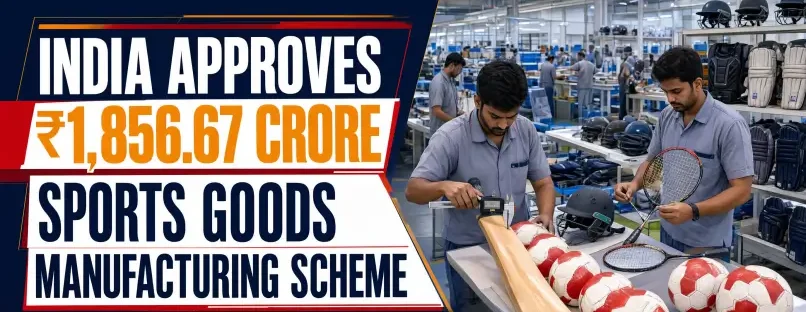

India is preparing to expand its manufacturing ambitions into the global sports equipment industry, with the government approving a dedicated ₹1,856.67 crore scheme to strengthen domestic production, attract investment and improve export competitiveness.
The Khelo India Sports Goods Manufacturing Scheme, approved by the Union Cabinet on October 28, 2026, will operate over eight financial years, from 2026–27 to 2033–34. It brings together investment incentives, manufacturing infrastructure, research support, international certification and skill development under a single industrial policy framework.
The initiative reflects a broader effort to move beyond India’s traditional manufacturing strengths and develop specialised industries capable of supplying both domestic and international markets.
India already has established sports goods manufacturing clusters, particularly in Meerut in Uttar Pradesh and Jalandhar in Punjab. However, much of the sector remains dominated by smaller enterprises, which often face limitations in technology, product development, access to finance and international quality certification.
The new scheme aims to address these structural constraints and create a more integrated manufacturing ecosystem.
₹1,130 Crore Dedicated to Investment and Production
A major component of the programme is the combined allocation of ₹1,130 crore for Anchor Investment Support and Turnover Linked Support.
Under Anchor Investment Support, eligible investors committing at least ₹100 crore to establish manufacturing facilities in designated Sports Goods Manufacturing Zones can receive capital expenditure support of 20%.
The second component, Turnover Linked Support, is designed for manufacturers investing at least ₹10 crore. Eligible businesses can receive incentives of up to 15%, encouraging higher production and expansion of manufacturing capacity.
These incentives are intended to attract established domestic companies as well as international manufacturers, brands and retail chains.
The policy approach is significant because manufacturing growth requires more than the establishment of individual factories. Large investors can create demand for local suppliers, component manufacturers, logistics providers and specialised service businesses.
If implemented effectively, the scheme could help develop a wider industrial network around sports equipment production.
Dedicated Manufacturing Zones to Build Industrial Clusters
The scheme proposes integrated Sports Goods Manufacturing Zones that will bring manufacturers, suppliers, testing facilities, design centres, prototyping units and ancillary businesses together.
These zones are expected to be developed in convergence with the BHAVYA Scheme and industrial parks supported by the National Industrial Corridor Development Corporation.
The government has indicated the possibility of four integrated zones, each covering more than 300 acres.
Cluster-based manufacturing can offer several advantages. Businesses operating in close proximity can share infrastructure, reduce logistics costs, access specialised testing facilities and collaborate on product development.
For smaller manufacturers, access to common facilities can reduce the investment required to upgrade production processes and meet international standards.
The proposed zones could also help attract companies that currently depend on manufacturing networks outside India.
However, their success will depend on implementation, infrastructure readiness, investor participation and the availability of skilled workers.
MSMEs Remain Central to the Manufacturing Strategy
Micro, small and medium enterprises account for nearly 90% of India’s sports goods production, according to the government’s scheme backgrounder.
This makes the sector particularly important for employment, local enterprise and regional industrial development.
Existing manufacturing clusters will receive support to upgrade common facilities and shared infrastructure through arrangements involving state governments.
Such support can help smaller businesses improve production quality without requiring every manufacturer to independently invest in expensive equipment and facilities.
The initiative is also relevant for traditional manufacturing centres such as Meerut and Jalandhar. These locations already have established supplier networks and industry experience, which could provide a foundation for further expansion.
Nevertheless, the scheme does not automatically guarantee that existing clusters will receive specific allocations or that all manufacturers will qualify for incentives. Implementation guidelines and eligibility conditions will determine the actual distribution of benefits.
International Certification Becomes a Key Export Priority
One of the challenges facing Indian sports goods manufacturers is the ability to meet international performance and safety standards.
Products intended for professional sports and international competitions often require certification from recognised sports federations. Without the necessary approvals, manufacturers may find it difficult to enter certain international markets.
The scheme allocates ₹105 crore to support manufacturers in obtaining and renewing certifications from International Sports Federations.
The assistance is designed to cover 70% of first-time certification costs and 50% of renewal costs, according to the government’s scheme details.
This could be particularly useful for smaller businesses that have the manufacturing capability to produce specialised equipment but lack the financial resources to complete international certification processes.
Improved certification access can strengthen buyer confidence, expand export opportunities and help Indian manufacturers move towards higher-value products.
Research, Start-ups and Advanced Manufacturing
The programme also seeks to strengthen research and product innovation through Centres of Excellence at leading educational and research institutions.
The focus areas include sports equipment, material sciences, protective gear and advanced manufacturing technologies.
DPIIT-registered sports goods start-ups will also be eligible for grants of up to ₹20 lakh to support product development, testing, validation and commercialisation.
This creates an opportunity for businesses working on specialised equipment, new materials and improved manufacturing processes.
The government also plans to encourage research collaboration through the Anusandhan National Research Foundation and support skill development in coordination with the Ministry of Skill Development and Entrepreneurship.
The emphasis on research is important because global sports equipment markets increasingly reward product performance, durability, material innovation and specialised design rather than manufacturing scale alone.
Can India Compete in the Global Sports Goods Market?
The global sports equipment market was valued at approximately $140 billion in 2024, according to the government’s scheme backgrounder, which projects significant expansion in the coming years.
India’s established manufacturing clusters and large MSME base provide an initial foundation. However, competing internationally will require consistent quality, reliable supply chains, product innovation and stronger global distribution networks.
The scheme is expected to support India’s efforts to reduce import dependence, increase domestic value addition and expand exports. These are policy objectives rather than guaranteed outcomes.
Its effectiveness will ultimately depend on whether the incentives translate into actual factory investments, higher production, internationally recognised products and sustained demand from overseas buyers.
For India, the sports goods initiative represents an attempt to turn an established but fragmented manufacturing sector into a more organised industrial ecosystem. If the proposed investments, manufacturing zones and certification support are implemented successfully, the sector could create new opportunities for MSMEs, larger manufacturers, technology providers and exporters.
Nikhil Varma
Nikhil Varma covers India’s growth model, emerging-market policy credibility, digital infrastructure and global capital links.


